Reference / Hardware
Zigbee networks: plan devices, messages and maintenance
Zigbee combines radio networking with a shared application language for connected devices. A usable installation also needs defined device roles, commissioning, security, an application data model, a power budget and recovery after failure.
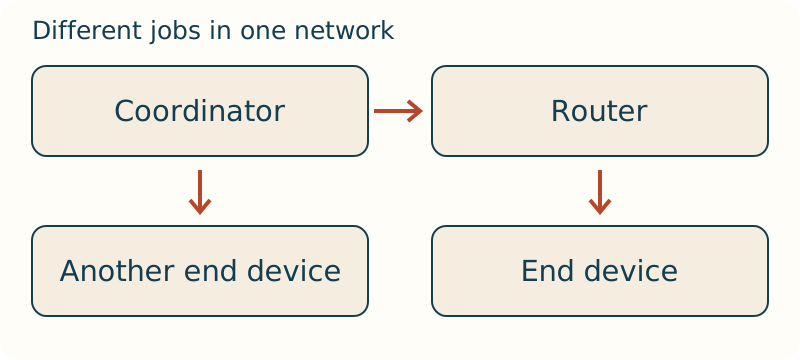
Choose by message and maintenance needs
Start with payload, reporting interval, latency tolerance, device count and battery-replacement plan. Occasional telemetry is different from a control loop or a device that must receive commands quickly.
A mesh can offer alternate paths, but it needs placement and powered routing participants. Test realistic walls, interference, firmware behaviour and loss of a mains-powered node.
Plan commissioning and interoperability
A radio module can simplify RF design but cannot automatically make applications interoperable. Define device types, joining, key protection and replacement of a lost controller.
Verify joining, normal reporting, power loss, reset and secure removal. Treat claimed range as a scenario to test, not as a substitute for an installed-site measurement.
Design the device lifecycle
Decide who owns a device after installation, how it receives updates and what happens when a tenant, battery or controller changes. Commissioning is only the beginning of operation.
Keep factory-reset behaviour controlled. A reset that silently rejoins a network or exposes an actuator can turn maintenance into a security event.
Separate radio reachability from device meaning
A Zigbee installation has at least two questions. One is whether a device can participate in the mesh and exchange messages over the radio path. The other is whether the receiving application understands the device’s information and can use it safely. Zigbee is a full-stack system with a mesh network and a shared language for smart objects; that is why a successful join is necessary but not sufficient evidence of an interoperable outcome.
Take a temperature sensor as a design exercise. “A value arrived” is not an application contract until the consumer knows the unit, the measurement state, the reporting condition and what absence of a new value means. The radio path may be healthy while the application makes a bad decision from stale or differently interpreted data. Treat transport success and semantic correctness as separate acceptance tests, so a radio diagnosis is not used to excuse an integration error.
Specify the message before placing the hardware
Write each device contract in plain operational terms: what it measures or controls, the values it sends or accepts, the state that makes a command safe, and the acknowledgement that proves the intended action. A battery sensor reporting occasionally and an actuator receiving a control command have different failure consequences. The first may tolerate delayed information; the second may need the application to distinguish “command was accepted” from “the physical result is now known.”
This exercise also exposes traffic trade-offs. Reporting every small change can create frequent activity without improving the decision, while long intervals can conceal a stopped device. Do not choose an interval from a product label. Choose it from the maximum age of information the receiving process can tolerate, then test the missing-report case explicitly. The design is complete only when the application knows whether silence is normal, expected sleep or a fault needing investigation.
Use mesh paths as a design variable
Zigbee is described as a low-power, self-organising and self-healing mesh. Those words should lead to a placement question, not a range promise. Identify the fixed points that can provide stable forwarding opportunities, the areas where devices sleep, and the physical changes that could remove a useful path. A mesh can offer alternatives, but an alternative is valuable only if the remaining topology still carries the required messages with acceptable delay and power use.
Test a planned loss, such as removal of a powered routing point, during an authorised commissioning exercise. Observe whether essential devices regain a usable path and whether the application notices any period without reports. Do not call the test a guarantee of every future layout; it is evidence for this topology and this failure. The trade-off is visible: extra placement and powered infrastructure can improve path options, while battery autonomy limits how aggressively an endpoint can participate.
Commission identity and replacement deliberately
Joining is the moment when a physical object becomes an authorised participant in a system. Record the intended device role, its location, the controller that owns its configuration and the procedure for removing it. A quick “add device” action is not enough for an actuator: later maintenance must answer which object a command refers to, whether the old unit has been removed, and whether a replacement inherited only the intended settings.
Run a replacement drill before deployment. Remove a noncritical test device, confirm that the application presents its loss as loss rather than as a believable last value, then add the replacement and verify its first report or command separately. This catches a subtle operational fault: a dashboard can appear calm while it is showing data from a device that is no longer part of the installation. The test is about identity continuity, not a claim that every product handles replacement identically.
Test interoperability at the application boundary
A common radio foundation does not erase differences in device functions, user interface assumptions or controller data models. Zigbee certification and a shared application language are relevant evidence for interoperability, but the installed job still needs a defined interaction to test. Choose one useful cross-device outcome—such as a sensor state causing a named controller rule to evaluate—and state exactly which values and states must pass between the two.
Test normal operation, a malformed or unavailable value, and the behaviour after one participant returns. This distinguishes radio reachability from application compatibility. It also avoids the expensive mistake of declaring two products integrated because both appeared in a commissioning screen. The application boundary is where the user experiences the system; it deserves the same explicit inputs, outputs and fault cases as any other interface.
Make maintenance failures visible
Low-power devices make absence ambiguous. A missed message may reflect a planned sleep cycle, changed placement, depleted energy, a lost mesh path or a controller fault. Define a per-device freshness rule and a response for crossing it. The rule should depend on the device contract: a sensor used for a daily trend can have a different tolerance from an actuator whose state informs a safety decision.
Include reset, power loss and controller recovery in acceptance testing. After each event, verify not only that the device returns to a network view but that its intended message or command is again meaningful to the application. This keeps maintenance from becoming a radio-only ritual. The useful outcome is an installation whose faults are classified early enough to be repaired before stale state is mistaken for current state.